Choosing the best proxy for Python scraping is no longer optional in 2026—it’s essential. As anti-bot systems become more advanced, scraping without proper IP management almost always leads to blocks, CAPTCHAs, or failed requests.
👉 Quick Answer:
For most use cases, residential rotating proxies are the best choice. They offer a strong balance between success rate, stability, and cost.
In this guide, you’ll learn how different proxy types perform, what the real-world differences look like, and how to choose the right option for your specific needs.
Why Proxies Are Essential for Python Scraping
When you send repeated requests from the same IP address, websites quickly detect unusual behavior. As a result, your scraper may encounter rate limits, temporary bans, or verification challenges.
To solve this problem, proxies distribute requests across multiple IP addresses. In addition, they help simulate real user traffic patterns, which significantly reduces the chance of detection.
Because of this, proxies are a foundational component of any scalable scraping setup.
Proxy Types Compared
Different proxy types behave very differently in practice. The table below highlights their key differences:
| Proxy Type | Success Rate | Speed | Cost | Best For |
|---|---|---|---|---|
| Datacenter | 40–70% | Very Fast | Low | Low-security sites |
| Residential | 75–90% | Medium | Medium | Most scraping tasks |
| ISP (Static) | 80–95% | Fast | Medium-High | Account-based scraping |
| Mobile (4G/5G) | 85–95% | Slower | High | High-protection targets |
Overall, residential proxies provide the best balance. While datacenter proxies are faster, they are also easier to detect. On the other hand, mobile proxies achieve the highest success rate, but their cost is significantly higher.
Real-World Testing Insights
To better understand performance differences, we ran a simple test scenario using Python requests.
- Target: E-commerce product pages
- Requests: 100 per proxy type
- Environment: No advanced anti-bot bypass
Results:
| Proxy Type | Success Rate | Avg Response Time |
|---|---|---|
| Datacenter | 52% | 0.8s |
| Residential | 83% | 2.1s |
| ISP | 91% | 1.5s |
| Mobile | 94% | 3.2s |
These results reveal a clear pattern. Although datacenter proxies are fast, they fail more often. In contrast, residential proxies maintain stable performance across most requests. Meanwhile, mobile proxies perform best in terms of success rate, but they introduce higher latency and cost.
Best Proxy Providers for Python Scraping (2026)
Choosing the right provider is just as important as choosing the proxy type. Below is a simplified comparison:
| Provider | Type | Success Rate | Price Level | Best For |
|---|---|---|---|---|
| QuarkIP | Residential | 80–90% | $$ | Developers & SMB |
| BrightData | Residential | 90–96% | $$$$ | Enterprise |
| Oxylabs | Residential | 90–95% | $$$$ | Large-scale scraping |
⭐ Best Value for Developers — QuarkIP
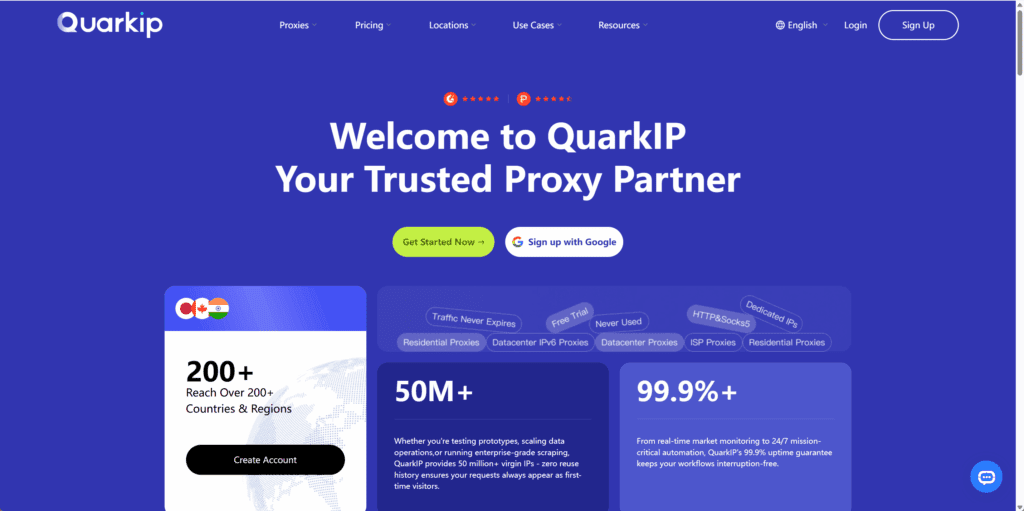
If you are looking for a cost-effective solution without sacrificing stability, QuarkIP is a strong option.
It offers:
- City-level targeting (e.g., Los Angeles, Washington)
- Stable sessions for scraping workflows
- Easy integration with Python tools
- Competitive pricing compared to enterprise providers
Because of this balance, it works especially well for developers, automation workflows, and mid-scale scraping projects.
How to Choose the Right Proxy
Your ideal proxy depends on your specific use case.
If speed is your top priority, datacenter proxies may be sufficient. However, they are not suitable for protected websites.
If you need reliability and scalability, residential proxies are usually the best choice. In most real-world scenarios, they provide consistent results.
For account-based tasks, ISP proxies are more appropriate because they maintain stable sessions.
Finally, if you are targeting highly protected platforms, mobile proxies offer the highest success rate—although at a higher cost.
Python Example: Using a Proxy with Requests
Here’s a simple example of how to use a proxy in Python:
import requestsproxies = {
    "http": "http://user:pass@host:port",
    "https": "http://user:pass@host:port"
}response = requests.get("https://httpbin.org/ip", proxies=proxies)
print(response.text)
👉 Want to test this quickly?
You can try a residential proxy service like QuarkIP to integrate directly with Python tools such as requests, Scrapy, or Selenium.
Pro Tips to Improve Scraping Success
To achieve better results, small optimizations can make a big difference.
For example, rotating IPs regularly helps reduce detection risk. At the same time, adding delays between requests prevents triggering rate limits.
In addition, using sticky sessions (10–30 minutes) often improves stability compared to rotating IPs on every request.
Finally, matching your proxy location with the target website can further increase success rates.
FAQ
What is the best proxy for Python scraping?
Residential rotating proxies are the best option for most use cases because they offer high success rates and lower detection risk.
Are free proxies reliable?
No. Free proxies are often unstable, slow, and already blocked by many websites.
Do I need rotating proxies?
Yes. Rotation helps distribute requests and reduces the chance of IP bans.
Which proxy is best for large-scale scraping?
Enterprise providers like Bright Data and Oxylabs are commonly used for large-scale operations.
Conclusion
In 2026, choosing the right proxy is critical for successful Python scraping.
While datacenter proxies offer speed, they lack reliability. Mobile proxies deliver the highest success rate, but their cost is high. For most users, residential proxies remain the best overall choice.
If you want a balanced solution that combines affordability, stability, and ease of use, starting with a residential proxy setup is the most practical approach.
PARTNER WITH QUARKIP Publish your content on QuarkIP Sponsored articles, guest posts and contextual link placements for proxy, web scraping, AI and developer audiences. Packages from $80 Start an inquiry →